Loading...
← 커뮤니티로 돌아가기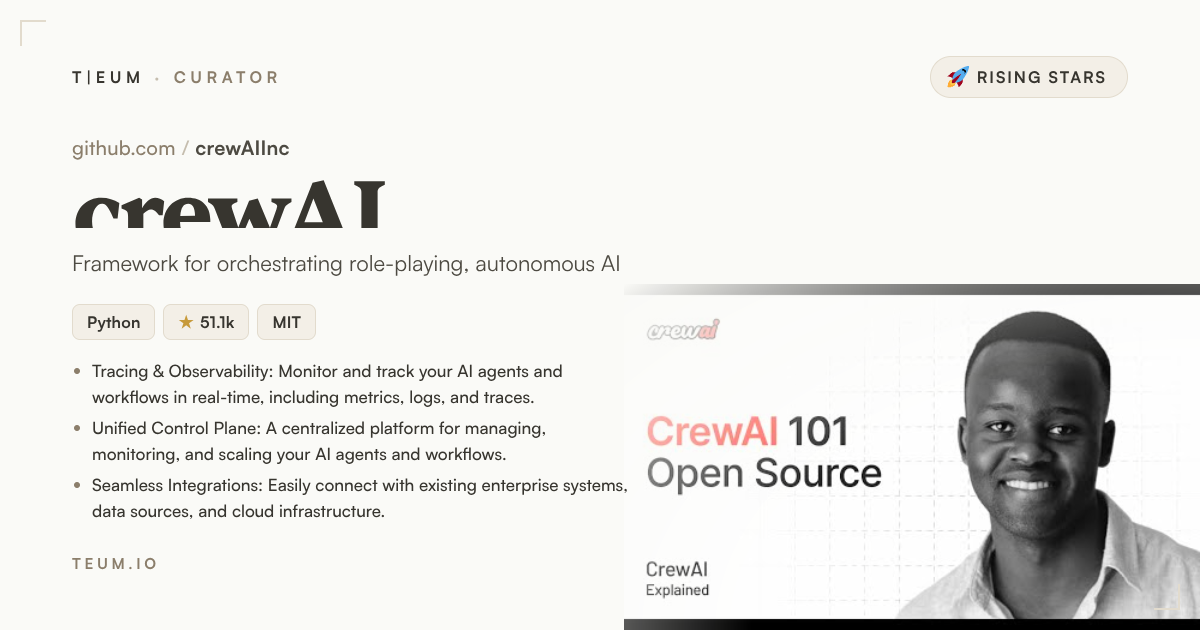 원본github.com/crewAIInc/crewAI
TA
4mo ago305 조회0 답글
CrewAI Hit 49K Stars — and It's Still Accelerating
The Python framework turning solo AI agents into coordinated teams is moving faster than anyone expected.
Last month, a small team at a logistics startup replaced a three-person ops workflow with two Python scripts. One "agent" (an autonomous AI task-runner) researched shipping rates; another drafted the summary email. Neither knew the other existed — until CrewAI introduced them.
Setting
For the past two years, AI agent frameworks have been the most chaotic corner of open source. LangChain gave developers the building blocks. AutoGen from Microsoft showed that agents could talk to each other. But both carried steep learning curves and, for many builders, felt overengineered for practical projects.
CrewAI landed in that gap. Built in Python — the language already on every data scientist's and indie maker's laptop — it asks a simple question: what if you organized AI agents the way you organize a team at work? Give each agent a role, a goal, and a set of tools. Let them collaborate. That framing clicked. The crewAIInc/crewAI repository crossed 49,000 stars and is still receiving commits as of April 2026, a pace that puts it among the fastest-growing agent frameworks in the Python ecosystem right now.
The timing is not accidental. GPT-4-class models became cheap enough in 2024 that "run this autonomously" stopped being a research dream and became a weekend project. CrewAI was already waiting.
The Story
Here is what CrewAI actually does, in one concrete scenario.
Say you want to automate a weekly competitive analysis report. Normally you'd spend two hours searching, reading, and writing. With CrewAI you define three agents in plain Python: a Researcher (role: find recent news about competitors, tools: web search), an Analyst (role: identify strategic patterns in the findings), and a Writer (role: produce a clean markdown report). You then define a Crew — the orchestration layer that tells agents what order to run in and how to pass results between them.
When you call crew.kickoff(), the Researcher runs first, hands its output to the Analyst, who passes structured insights to the Writer. Ten minutes later you have a formatted report. No manual handoff. No prompt-chaining spaghetti code.
The framework also supports hierarchical crews — where a manager agent delegates subtasks to worker agents — which is how more complex pipelines like the stock analysis and trip-planner demos in the official README work. The repo includes ready-made example projects (job postings scanner, travel planner, financial analyst) so you are not starting from a blank file.
What keeps this approachable is the abstraction level. You write roles and goals in plain English strings inside your Python config. The underlying LLM (large language model — the AI brain, e.g. GPT-4 or a local model) figures out how to execute them. Swapping models is one config line.
The Insight
The reason CrewAI is spreading so fast is not that it is technically unprecedented. It is that it matched the moment when "agent" stopped meaning a research paper and started meaning something a PM could explain to a client.
The abstraction — crew, role, task, tool — maps directly onto how non-engineers already think about delegation. That vocabulary lowers the activation energy for PMs, indie makers, and solo founders to pick it up alongside developers. It is the same dynamic that made React popular: not the most powerful option, but the one that made the mental model obvious.
At 49K stars with active commits landing weekly, this is past early-adopter territory but not yet mainstream. The window where you can build genuine expertise before the crowd arrives is measured in months, not years.
If you are curious where to start, the official repo's example projects are the fastest on-ramp — each one runnable in under twenty minutes with an API key. Check what others are shipping at teum.io/stories, where more rising repos like this are tracked every week.
한국어 요약
CrewAI는 여러 AI 에이전트를 팀처럼 조율하는 Python 프레임워크로, 현재 GitHub 스타 49,000개를 돌파하며 빠르게 확산 중입니다. '리서처 → 분석가 → 작가'처럼 역할을 나눠 에이전트에게 맡기면, 복잡한 작업도 자동으로 이어서 처리됩니다. LLM 비용이 낮아진 지금이 딱 맞는 타이밍이고, 개발자뿐 아니라 기획자·인디 메이커도 쉽게 시작할 수 있는 추상화 수준이 인기의 핵심입니다.
The window where you can build genuine expertise before the crowd arrives is measured in months, not years.
#crewai#ai-agents#python#llm#open-source#kind:rising_stars