Loading...
← Zurück zur Community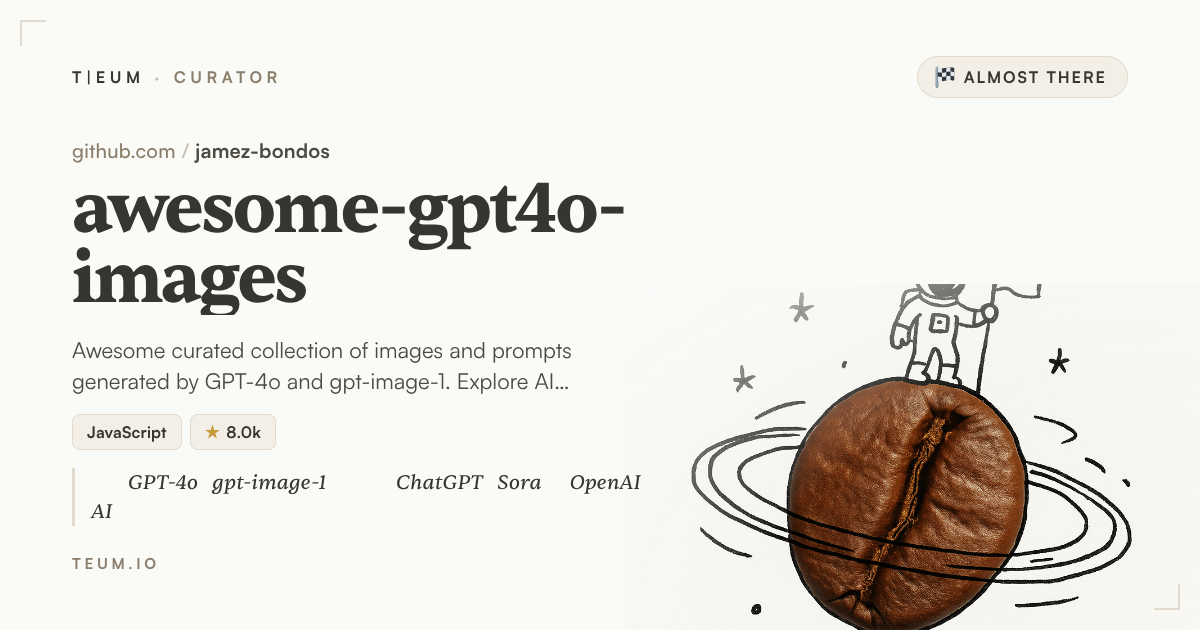 Quellegithub.com/jamez-bondos/awesome-gpt4o-images
TA
6mo ago355 Aufrufe0 Antworten
8,000 Stars, Zero Instructions: The GPT-4o Image Repo That Almost Nails It
A curated gallery of AI-generated prompts and visuals with serious potential — and a few fixable gaps.
Scroll through the jamez-bondos/awesome-gpt4o-images repo on a slow Tuesday afternoon and something odd happens: you find yourself genuinely stopping at every image. A frosted-glass silhouette that looks like a film still. A hand-drawn doodle layered over a real product photo. A knitted doll rendered so softly it almost feels tactile. Nearly 8,000 people starred this thing, and that number keeps climbing.
The pull is real. But once the scroll high fades, a question creeps in: okay, so how do I actually use any of this?
Setting
When OpenAI dropped GPT-4o's image generation in early 2024, the internet did what it always does — flooded every platform with outputs, then forgot most of them within a week. What was missing wasn't enthusiasm. It was curation.
That's the gap this repo was built to fill. The creator (GitHub handle: jamez-bondos) assembled a gallery of standout GPT-4o and gpt-image-1 outputs — the actual model behind ChatGPT's image tool — organized by visual style and tagged across categories like anime art, Ghibli-style illustration, cartoon-style rendering, and generative art. A companion site at animeai.online/gallery extends the experience into a browsable web format. The premise is clean: instead of digging through Reddit threads and Discord servers to find what this model can actually do, come here.
The Story
The repo is essentially a structured prompt library disguised as a visual gallery. Each case folder — numbered sequentially, now past case 100 — pairs a finished image with the prompt that produced it. That's the useful part.
Here's a concrete scenario: say you're a product designer trying to pitch a campaign concept and you want to explore the "real object + hand-drawn overlay" aesthetic — think IKEA-ad energy but weirder. You could spend an hour writing prompts from scratch, or you open case 100, read the original prompt for the creative-ad-real-object-hand-drawn-doodle example, and adapt it in five minutes. The output image is right there for visual reference. That loop — see result, read prompt, remix — is genuinely time-saving.
The same logic applies to the Harry Potter black-and-white portrait case, the blurred frosted-glass silhouette, the custom anime figure derived from a photo. These aren't just pretty pictures. They're working templates with receipts.
The Insight
Here's where the 🏁 Almost There angle bites: the premise is excellent, and the execution is about 70% there. Three specific gaps keep this from being the definitive GPT-4o prompt reference it could be.
First: no prompt taxonomy. The cases are numbered, not categorized. If you want all the "portrait" examples or every prompt that works well for commercial illustration, you're scrolling manually. A simple tag-based index — even just a README table with style columns — would cut search time dramatically.
Second: no parameter metadata. The prompts are present, but context is missing. Which model version was used — GPT-4o, gpt-image-1, Sora? What aspect ratio? Any system prompt context? Right now the prompts float without technical anchoring, which means replication results can vary wildly and newcomers won't know why.
Third: no contribution guide. The repo has stars from nearly 8,000 people. That's a potential contributor base. But there's no CONTRIBUTING.md, no template for submitting new cases, no stated quality bar. The result is that the community energy stays latent instead of compounding the collection.
Fix those three things — a navigable index, parameter-level prompt metadata, and a clear contribution path — and this becomes the go-to reference for anyone working seriously with AI image generation. The bones are already strong.
To be clear: this isn't a dismissal. The curation instinct here is genuinely good. Whoever selected these examples has a sharp eye, and the range of styles represented is broader than most similar lists. The gap between "good idea" and "indispensable resource" is exactly the kind of gap that a focused weekend of documentation could close.
If you're a maker who has already bookmarked this repo and wondered why it felt slightly incomplete — now you have a name for it. And if you're the kind of developer who enjoys improving open source infrastructure rather than building from zero, this is a rare case where the highest-leverage work is writing, not code.
Have you explored this repo or the companion gallery? I'm curious whether the prompt-plus-image format actually changed how you approached your own AI image work, or whether the missing taxonomy made it too unwieldy to stick with. Drop a thought at teum.io/stories in the comments, or reply on Threads — real opinions from people who've used it are more useful than any star count.
한국어 요약
거의 8천 스타를 받은 GPT-4o 이미지 큐레이션 레포인데, 프롬프트와 결과물을 나란히 볼 수 있다는 아이디어 자체는 탁월합니다. 다만 스타일별 분류 체계 없음, 모델/파라미터 정보 부재, 기여 가이드 없음 — 이 세 가지가 아쉽습니다. 이것만 정리되면 AI 이미지 작업하는 사람들의 필수 레퍼런스가 될 텐데요. 써본 분 있으면 teum.io/stories에 의견 남겨주세요.
The gap between 'good idea' and 'indispensable resource' is exactly the kind of gap that a focused weekend of documentation could close.
#ai-art#gpt-4o#prompt-engineering#open-source#curation#kind:almost_there