Loading...
← Zurück zur Community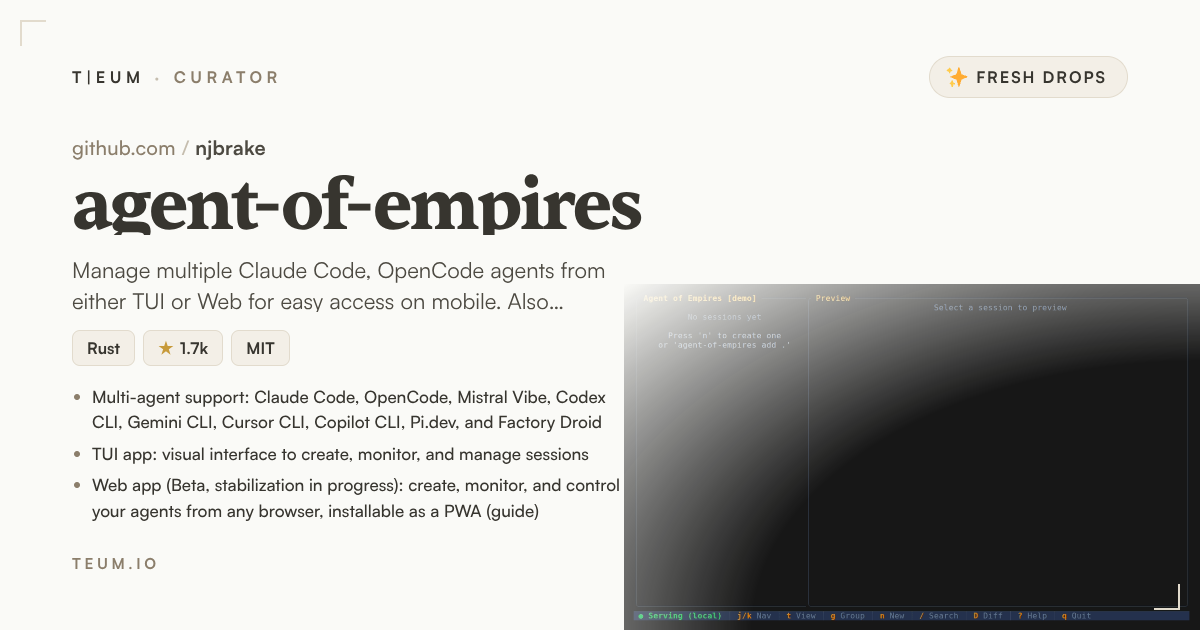 Quellegithub.com/njbrake/agent-of-empires
TA
6mo ago394 Aufrufe0 Antworten
One Dashboard to Rule Your AI Coding Agents
Agent of Empires lets you run Claude, Gemini, Codex, and more — all at once, from a terminal or your phone.
It showed up on GitHub two days ago with 1,700 stars and almost no README. That gap between attention and documentation is usually a red flag — or a signal that something landed before its creator had time to explain it.
Setting
Right now, the AI coding agent landscape looks like a browser with forty tabs open. Claude Code, Codex CLI, Gemini CLI, Copilot CLI, Factory Droid — each one is genuinely useful, and each one wants to be the only terminal window you have open. Most developers end up running two or three of them anyway, context-switching manually, losing track of which agent is working on which branch. Agent of Empires is njbrake's answer to that chaos: a single control layer that manages all of them simultaneously, written in Rust for speed, and accessible from either a TUI (a text-based interface that lives in your terminal) or a web dashboard you can pull up on your phone.
The repo is fresh enough that the README is still sparse, but the description alone is dense with intention: tmux (a terminal multiplexer that keeps sessions alive in the background) plus git worktrees (a Git feature that lets you check out multiple branches at the same time, in separate folders). That combination means each agent can work on its own branch, in its own isolated environment, without stepping on the others.
The Story
Here is a concrete scenario. Say you are building a feature and you want Claude Code to write the core logic while Gemini CLI reviews the same codebase for security issues — in parallel, not sequentially. Normally that means two terminal windows, two sessions, zero coordination. With Agent of Empires, you spin up both agents from a single TUI, each one pointed at its own git worktree (so they are literally working in separate copies of the repository), and you monitor their output from one screen.
Now say you step away from your desk. Because the web dashboard is part of the same tool, you can check progress from your phone without SSH-ing into anything. The agents keep running under tmux in the background. You come back, see what each one produced, and merge the branch you like.
The tool also supports Mistral Vibe, Pi.dev, and Factory Droid CLI — a list that reads like the creator wanted to make sure no popular agent was left out. Whether all of those integrations work cleanly at this stage is genuinely unknown. The repo is two days old. That is not a criticism; it is just the honest state of a fresh drop.
The Insight
The interesting design choice here is not "support more agents" — it is the decision to treat agents the way a senior engineer treats parallel branches: separate contexts, separate outputs, one place to see everything. Most orchestration tools for AI agents focus on chaining them in sequence (agent A hands off to agent B). Agent of Empires goes sideways instead of forward — run them in parallel, compare results, pick the winner. That is a meaningfully different mental model, and Rust as the implementation language suggests the author cares about the tool not getting in its own way under load.
Completeness is not the point yet. The direction is.
If you are the kind of person who cloned early VS Code extensions before they had settings pages, or who ran local LLMs before there were one-click installers, this repo is worth a look this week rather than next month. The stars suggest a lot of people had the same instinct. Whether the project matures into something polished or forks into ten different ideas — either outcome is interesting to watch. Fresh drops like this one are catalogued weekly at teum.io/stories, if you want a reliable way to catch them before the README catches up.
한국어 요약
Claude Code, Gemini CLI, Codex 같은 AI 코딩 에이전트를 동시에 여러 개 돌리고 싶을 때, 터미널 창을 여러 개 띄우는 대신 하나의 TUI나 웹 대시보드로 관리하는 도구입니다. tmux와 git worktree를 활용해 에이전트마다 독립된 브랜치에서 병렬 작업이 가능하고, 모바일에서도 진행 상황을 확인할 수 있습니다. 2일 전 올라온 따끈한 레포로 완성도보다는 방향이 독특한 프로젝트입니다.
The interesting design choice is not 'support more agents' — it is the decision to treat agents the way a senior engineer treats parallel branches: separate contexts, separate outputs, one place to see everything.
#ai-agents#cli-tools#rust#developer-tools#fresh-drops#kind:fresh_drops