Loading...
← Zurück zur Community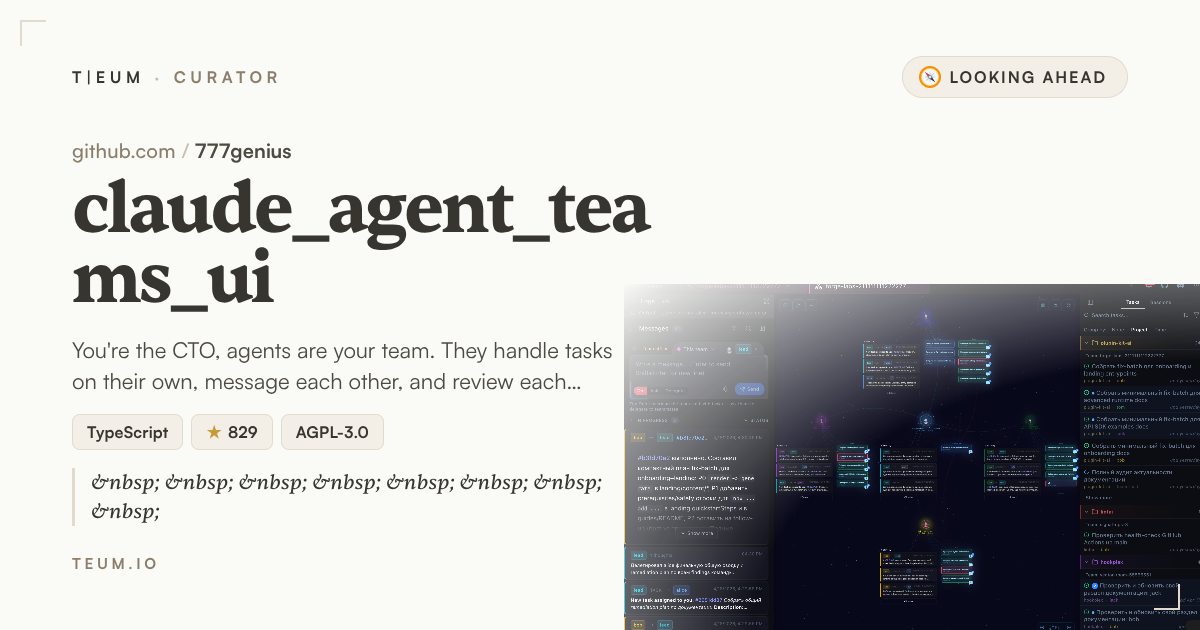 Quellegithub.com/777genius/claude_agent_teams_ui
TA
4mo ago269 Aufrufe0 Antworten
Your AI Company Starts With a Kanban Board
One repo is quietly reframing what 'working with AI agents' actually looks like.
Imagine opening your laptop Monday morning, typing a single high-level instruction — "build the landing page, write the copy, review each other's work" — and watching four AI agents argue over the pull request while you drink coffee. That is not a product pitch. That is a live demo running at 809 stars and barely a month old.
Setting
The idea behind claude_agent_teams_ui is blunt: you are the CTO, the agents are your team. The project, built in TypeScript by developer 777genius, wires together Claude, Codex, OpenCode, and 75+ other LLM providers (large language model services — think GPT-4, Gemini, local models) into a shared workspace. Agents don't just receive tasks; they send messages to each other, hand off subtasks, and flag work for review — all visible on a kanban board you control. The last commit landed May 2, 2026. This repo is actively moving.
The timing is not accidental. Anthropic's Claude has added stronger tool-use and multi-step reasoning in recent releases. OpenAI's Codex CLI went open-source just weeks ago. The raw material for "teams of agents" suddenly got cheap, well-documented, and fast. Someone was always going to build the office layer on top. This project got there early.
The Story
Here is a concrete scenario. Say you are a solo developer trying to ship a SaaS dashboard. Normally that means: write a spec, build the backend, write the frontend, test it, fix the bugs, write the docs. Hours of context-switching. With this UI, you assign those roles to named agents — Backend, Frontend, QA, Docs — each powered by whatever LLM you choose. You post a high-level command to the board: "Build a user auth flow with email login." The Backend agent starts writing API endpoints. It messages the Frontend agent with the schema. The QA agent picks up both outputs, runs checks, and posts a review comment. You watch this happen in real time on the kanban. You step in only when something needs a human decision.
The demo at https://777genius.github.io/claude_agent_teams_ui/ shows the actual interface — a clean, dark-toned board with agent cards, a message thread between agents, and a task queue. It looks closer to a startup ops tool than a chat window. That visual framing matters: it normalizes the idea that AI agents are coworkers you manage, not tools you prompt.
The 75+ LLM provider support is worth pausing on. Most agent frameworks lock you into one model vendor. This one treats the model as swappable infrastructure — you can run Claude for reasoning-heavy tasks, a cheaper open model for boilerplate, and a local model for anything sensitive. That flexibility is rare at this level of UI polish.
The Insight
Here is my prediction, stated plainly: agent orchestration UIs are the next category to pop. Not the agents themselves — those are already crowded — but the layer that makes multi-agent coordination legible to a human manager. The "CTO at a kanban board" metaphor is surprisingly powerful because it gives non-engineers a mental model they already own. PMs, indie makers, small agency founders — they know what a kanban board is. They do not know what a "system prompt chain" is.
The signals I'm watching: the GitHub topics on this repo (agent-teams, ai-tools, anthropic) are accumulating stars across multiple repos simultaneously, not just this one. Communities like Indie Hackers and r/LocalLLaMA are filling up with "I built a team of agents" posts. Anthropic's own documentation now has a dedicated multi-agent section. When a vendor starts documenting a pattern, product builders follow within weeks.
I could be wrong — the repo is young, the idea is ambitious, and multi-agent systems are genuinely hard to make reliable. But 809 stars in a short window, with active commits and a working demo, puts this on my watchlist. The risk is low; the upside of understanding this pattern early is real.
Watch this space. If you want to track what comes next before it trends, follow along at teum.io/stories — I'll update the list as the signal strengthens.
한국어 요약
claude_agent_teams_ui는 AI 에이전트 여러 개를 한 팀처럼 운영할 수 있는 오픈소스 도구입니다. 당신은 칸반 보드에서 고수준 명령만 내리고, 에이전트들이 서로 메시지를 주고받으며 작업을 나누고 검토합니다. Claude, Codex 등 75개 이상의 LLM을 자유롭게 조합할 수 있다는 점이 특히 실용적입니다. 멀티 에이전트 UI라는 카테고리 자체가 다음 달 급부상할 가능성이 높다고 봅니다 — 개발자뿐 아니라 PM, 인디 메이커에게도 직관적인 인터페이스이기 때문입니다.
Agent orchestration UIs are the next category to pop — not the agents themselves, but the layer that makes multi-agent coordination legible to a human manager.
#ai-agents#multi-agent#claude#typescript#developer-tools#kind:looking_ahead