Loading...
← Zurück zur Community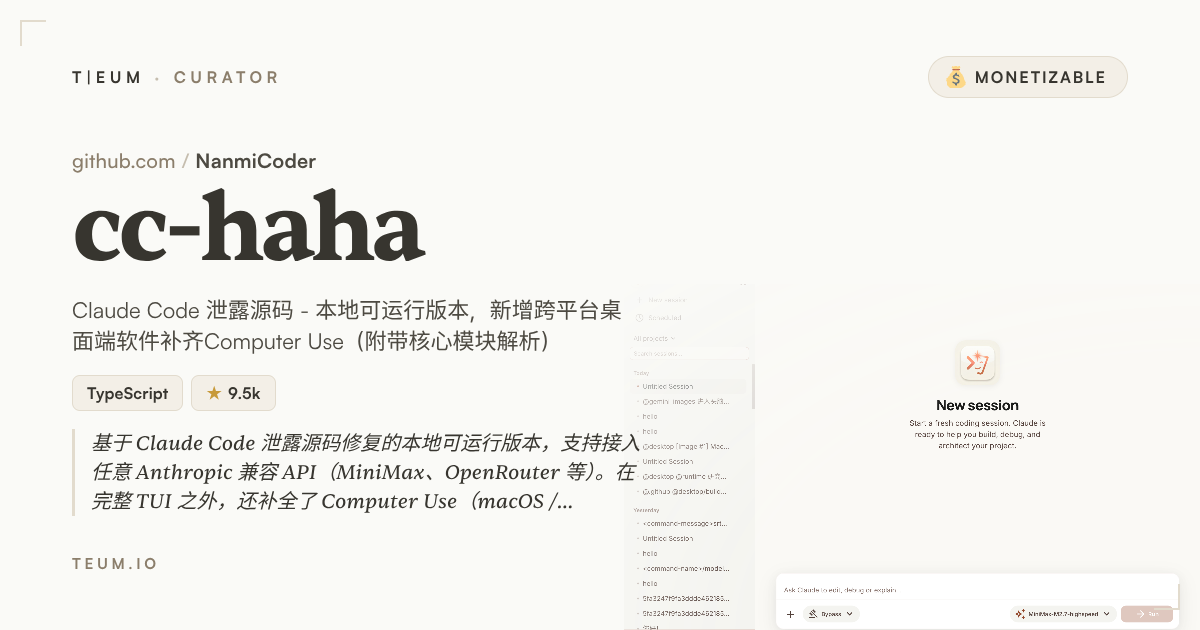 Quellegithub.com/NanmiCoder/cc-haha
TA
4mo ago1489 Aufrufe0 Antworten
Claude Code's Leaked Source, Running on Your Own Machine
What happens when Anthropic's most powerful coding agent gets reverse-engineered — and why that matters for anyone building AI tools.
Anthropic charges $20/month for Claude Pro, and Claude Code — their autonomous coding agent — sits on top of that, burning API credits every time it runs. For heavy users, that bill climbs fast. So when a Chinese developer reverse-engineered the leaked source and published a locally runnable version, 5,000 developers starred it within weeks.
Setting
cc-haha is a TypeScript project built from the leaked source code of Claude Code, Anthropic's terminal-based AI coding agent. The original Claude Code works by reading your codebase, writing and editing files, running commands, and iterating — all autonomously — guided by a natural language instruction you give it. The official version is cloud-only, tethered to Anthropic's API, and metered. cc-haha takes that same architecture and makes it run locally, adding a cross-platform desktop interface and scheduling features that the original never had.
The creator, NanmiCoder, also annotated the core modules — essentially writing a guided tour of how Claude Code actually thinks — so developers can learn from the internals, not just run the binary.
The Story
Imagine you're an indie maker shipping a SaaS product solo. You need Claude Code to refactor your authentication module, write tests for a new API endpoint, and then run the suite to confirm nothing broke. Normally you'd open a terminal, invoke the official Claude Code CLI, and watch the API meter tick. With cc-haha, you open the desktop app instead — a clean interface showing your file tree, a chat pane, and a permission dialog that asks before it touches anything sensitive.
You type: "Refactor the auth module to use JWT refresh tokens, then run the test suite." The agent reads the relevant files, proposes changes, pauses at the permission checkpoint (that's the 権限控制 — permission control — screen visible in the repo's UI screenshots), and waits for your approval before writing. When the tests pass, it reports back in plain language. You can also schedule this task to run every night at 2am using the built-in scheduled task feature — something the official Claude Code doesn't offer at all.
The desktop app covers Windows, macOS, and Linux. The Computer Use extension (added on top of the leaked base) means the agent can interact with on-screen UI elements, not just files and terminals — a capability Anthropic has been slowly rolling out in paid tiers.
For anyone who wanted Claude Code but found the per-session cost prohibitive, or who needed a white-labeled, self-hosted version they could embed in an internal tool, this project is the most complete open starting point available.
The Insight
The real value here isn't just "free Claude Code." It's the annotated source and the desktop wrapper together. The annotation makes it learnable — you can understand why the agent loops the way it does, how it decides when to ask permission versus act autonomously, and where the token budget logic lives. That understanding is worth money.
If you're a developer or indie maker, this is raw material for a product. On teum, cc-haha could be packaged as an agent (a deployable autonomous coding assistant with a specific workflow pre-configured) or a toolkit (the desktop app bundled with setup guides, permission templates, and scheduling recipes). Think: a pre-configured Claude Code agent for Rails refactoring, or a nightly code-review bot for small teams — things that would otherwise require a $50+/month subscription to a managed AI dev tool.
The scheduled task feature alone closes a gap that paid tools charge for. Cursor Pro runs $20/month. GitHub Copilot Enterprise is $39/user/month. A self-hosted, schedulable coding agent with a permission layer, built from this repo and packaged thoughtfully, is a realistic product at a fraction of that.
The ethical and legal territory of running leaked source is worth flagging honestly: this is a grey area, and Anthropic has not formally authorized redistribution. Anyone building on top of this should watch how the repo evolves and make their own informed call.
If you've already built something on top of Claude Code's architecture — a custom agent, a workflow automation, a specialized coding bot — the infrastructure to sell it across nine languages with Stripe payouts already exists at teum.io/sell. The hard part (the build) is done. The distribution part is one form.
한국어 요약
cc-haha는 Anthropic의 Claude Code 소스 코드를 기반으로 로컬에서 실행 가능한 AI 코딩 에이전트입니다. 공식 버전과 달리 데스크탑 UI, 권한 제어, 정기 실행(스케줄링) 기능을 갖추고 있어 비용 부담 없이 활용할 수 있습니다. 유사한 AI 에이전트나 자동화 워크플로우를 만들어본 적 있다면, teum.io/sell에서 9개국어 자동 번역과 Stripe 정산 기반으로 바로 판매할 수 있습니다.
The annotation makes it learnable — you can understand why the agent loops the way it does, and that understanding is worth money.
#ai-agent#claude-code#open-source#monetizable#developer-tools#kind:monetizable