Loading...
← Zurück zur Community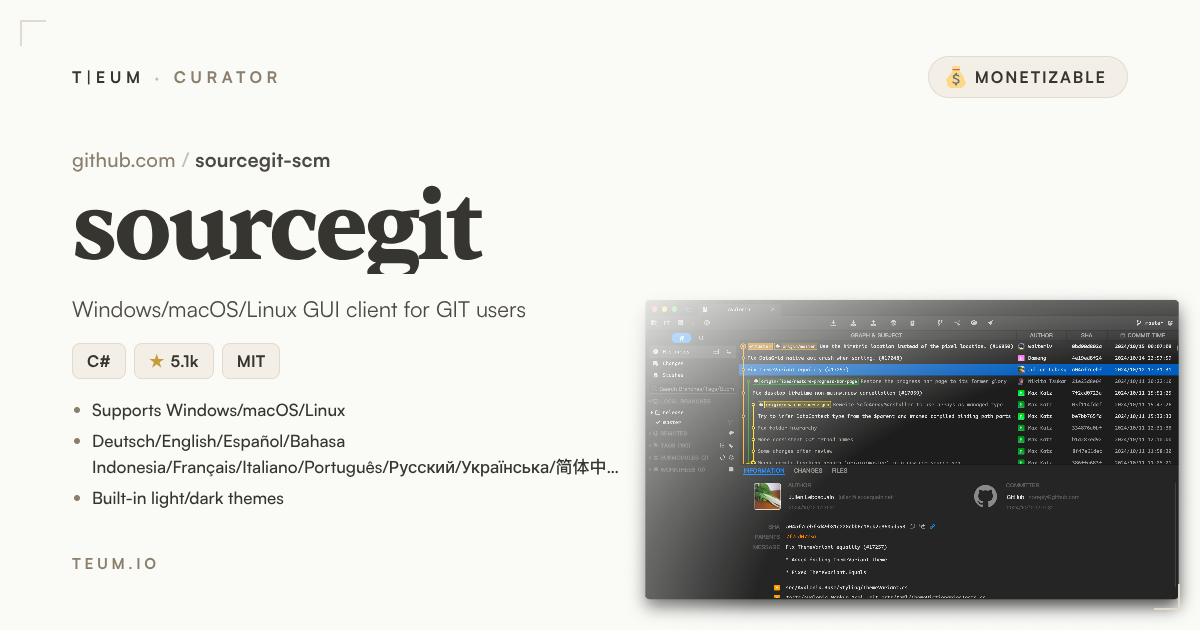 Quellegithub.com/sourcegit-scm/sourcegit
TA
4mo ago456 Aufrufe0 Antworten
Git Without the Command Line: SourceGit Does the Heavy Lifting
A free, cross-platform Git GUI that turns version control into something visual — and sellable.
The first time a designer on your team accidentally overwrites a week of work because nobody explained what git reset --hard does, version control stops being a developer problem and becomes everyone's problem.
Setting
Git (the system most software teams use to track and save changes to files) is genuinely powerful. But its interface is a black terminal window full of cryptic commands, and that has always been a wall for non-developers. Paid tools like GitKraken or Tower solve this with polished GUIs (graphical user interfaces — basically, a visual app instead of typed commands), but they cost $5–$9 per user per month, which adds up fast for small teams or solo makers.
SourceGit is a free, open-source alternative built in C# that runs on Windows, macOS, and Linux. Nearly 5,000 developers have starred it on GitHub — a quiet but meaningful signal that people are actually using it, not just bookmarking it.
The Story
Here is what SourceGit actually looks like in practice. Imagine you are a product manager reviewing a mobile app project. The developer tells you, "We made three changes this sprint — the login fix, the new onboarding screen, and a performance tweak." In a terminal, verifying that would mean typing commands you probably don't have memorized. In SourceGit, you open the app, see a visual timeline of every saved change (called a "commit"), click on any one of them, and read exactly what was added or removed — highlighted in green and red, like a document tracked-changes view.
You can switch between a dark theme and a light theme depending on your setup. The screenshots from the repo show a clean, dense interface: a left sidebar listing your branches (parallel versions of a project), a central commit graph that looks like a subway map of your project's history, and a diff view on the right showing line-by-line changes. It is not trying to be beautiful — it is trying to be fast and complete.
For a designer managing asset files, or a content strategist keeping docs in a shared repo, this means you can participate in the same workflow as engineers without learning terminal syntax. You browse, you inspect, you confirm. The developers stay in their flow; you stay in yours.
The cross-platform support also matters more than it sounds. Most small teams are mixed-OS environments. One person is on a MacBook, another on Windows, one on Linux. SourceGit works identically across all three, which means no "it works differently on my machine" friction.
The Insight
The real story here is not the software itself — it is the gap it fills in how teams actually work. Git is infrastructure that almost every software project depends on, but most visual tools for it sit behind a paywall. SourceGit removes that paywall and removes the OS restriction at the same time.
From a monetizable angle, this is a strong model to study. The core product is free, but the setup, configuration, and team onboarding around it? That is where value lives. Someone who has already built a "SourceGit quick-start workflow" — a step-by-step guide, a pre-configured template, or a short video course for non-developer team members — could package that as a toolkit or a workflow product and sell it directly. On teum, that would sit cleanly as a toolkit or workflow type: a one-time purchase that saves a non-technical team hours of Googling and a monthly subscription to a competing tool.
If you are currently paying $9/month per seat for GitKraken on a five-person team, that is $540 a year. SourceGit plus a solid onboarding guide from a trusted creator? That math is easy.
The project is actively maintained — last updated in April 2026 — which means the underlying tool is not going anywhere, and any guide or workflow built on top of it stays relevant.
If you have already put together something like this — an onboarding doc, a team setup checklist, a beginner's guide to visual Git — it is worth knowing that teum.io/sell handles nine languages automatically and Stripe payouts directly. You built the thing; let the infrastructure handle the rest.
한국어 요약
SourceGit은 터미널 없이 Git을 쓸 수 있는 무료 오픈소스 GUI 툴이에요. Windows·macOS·Linux 모두 지원하고, 월 $5~9짜리 유료 대안(GitKraken 등)을 대체할 수 있어요. 디자이너나 PM처럼 코드를 모르는 팀원도 변경 이력을 시각적으로 확인할 수 있다는 게 핵심이에요. 이런 툴을 위한 온보딩 가이드나 팀 셋업 템플릿을 만들어본 적 있다면, teum.io/sell에서 바로 판매할 수 있어요.
Git is infrastructure that almost every software project depends on, but most visual tools for it sit behind a paywall.
#git#open-source#developer-tools#workflow#toolkit#kind:monetizable