Loading...
← Retour à la communauté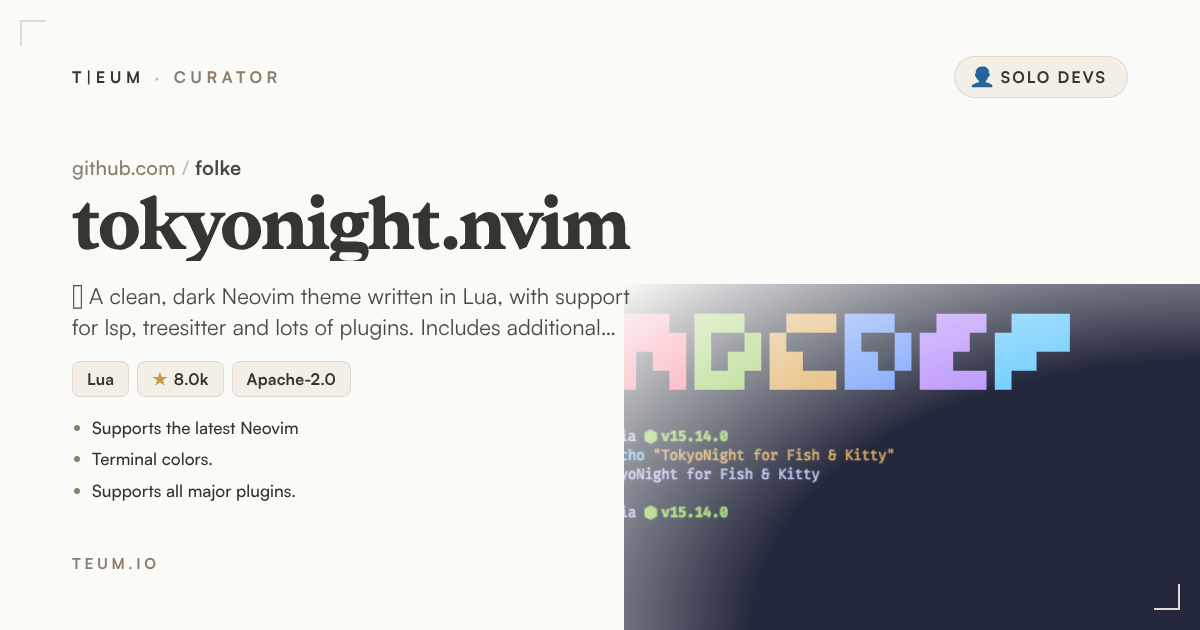 Sourcegithub.com/folke/tokyonight.nvim
TA
6mo ago430 vues0 réponses
One Person, One Color Scheme, 8,000 Stars
How folke's Tokyo Night theme became the de-facto Neovim aesthetic — and what solo makers can learn from it
There is a single Lua file at the center of roughly eight thousand developers' daily coding environment. One person wrote it.
Setting
Neovim (a keyboard-driven code editor popular among power users) had a theming problem a few years back. Most color schemes were ports from older editors — bitmapped, inflexible, and deaf to newer features like LSP (the system that powers real-time code diagnostics) and Treesitter (the parsing layer that gives editors smarter syntax highlighting). Folke Vercammen, a Belgian developer who maintains a constellation of Neovim plugins in his spare time, sat down and wrote tokyonight.nvim from scratch in Lua — the scripting language Neovim uses natively. The goal was clean, dark, and actually aware of the modern editor stack.
He did not work at a design agency. There was no brand committee. The commit history is essentially one person iterating in public.
The Story
Tokyonight is, on the surface, a color theme. In practice it is more like a design system for your terminal life. It ships four style variants — Storm, Night, Moon, and Day — each with a slightly different warmth and contrast balance. You pick the one that matches how your eyes feel at 11 p.m. versus 2 p.m.
But what actually earned the stars is the coverage. Install it once and it skins not just Neovim but also Kitty (a GPU-accelerated terminal), Alacritty (another fast terminal), iTerm2 (the Mac terminal most developers use), and Fish shell (a modern command-line shell). Before tokyonight, a developer who wanted visual consistency across all four tools spent an afternoon copy-pasting hex codes and hoping nothing looked wrong. After tokyonight, one plugin install and a two-line config produces a unified look from the moment you open a terminal to the moment you close a file.
A concrete example: a solo developer running a side project in TypeScript opens Neovim. Treesitter highlights function arguments in a soft lavender. LSP error underlines glow in a muted red that is visible without being aggressive. They switch to Kitty to run a test suite — same palette. They open iTerm to check a deployment log — same palette. The visual environment disappears, which is exactly the point. You stop noticing your tools and start noticing your code.
The last push to the repository was March 2025, more than four years after the first public release. Folke has kept it current through multiple Neovim API changes without letting it go stale — a maintenance record that puts most corporate open-source projects to shame.
The Insight
The solo angle here is not just a warm story. It is an argument about focus. A team building a color scheme would have run a survey, debated brand direction, and shipped something safe. Folke shipped something opinionated — a specific aesthetic rooted in the neon-washed visual language of Tokyo at night — and that specificity is exactly why people chose it. You cannot Google-by-committee your way to eight thousand stars. You earn them by having a point of view and holding it consistently over four years of maintenance.
The flip side is real: single-maintainer projects carry risk. If Folke stops, the issues pile up. That tension — personal focus versus institutional resilience — is the honest trade-off every solo maker accepts. The record here suggests the bet paid off. But it is worth naming it.
There is a quieter lesson too. Tokyonight is not a product anyone would have predicted a market for. "A color scheme that works across five terminal applications" is not a pitch deck slide. It is a solution to a personal annoyance that turned out to be a shared annoyance. That gap between "I needed this" and "eight thousand people also needed this" is where most worthwhile solo projects live.
If you have built something with that same shape — a precise fix for a specific friction, maintained with the kind of consistency that only personal investment produces — it is worth asking whether other people are quietly searching for the same thing.
Solo work that solves a real problem travels. If you are ready to let yours travel further, teum.io/sell handles the distribution side: automatic translations into nine languages and Stripe payouts, so the thing you built in your spare time can reach developers in Tokyo, Berlin, and São Paulo without extra work from you.
한국어 요약
folke/tokyonight.nvim은 혼자서 만든 Neovim 컬러 테마인데, 별이 8,000개에 달한다. Neovim뿐 아니라 Kitty, Alacritty, iTerm, Fish까지 한 번에 통일된 디자인을 입혀준다는 게 핵심이다. 4년 넘게 혼자 유지보수해온 집중력이 이 숫자를 만들었다. 혼자 만든 것도 충분히 팔 수 있다 — 준비됐다면 teum.io/sell을 확인해보자.
You cannot Google-by-committee your way to 8,000 stars. You earn them by having a point of view and holding it consistently.
#neovim#open-source#solo-dev#lua#developer-tools#kind:solo_devs