Loading...
← العودة للمجتمع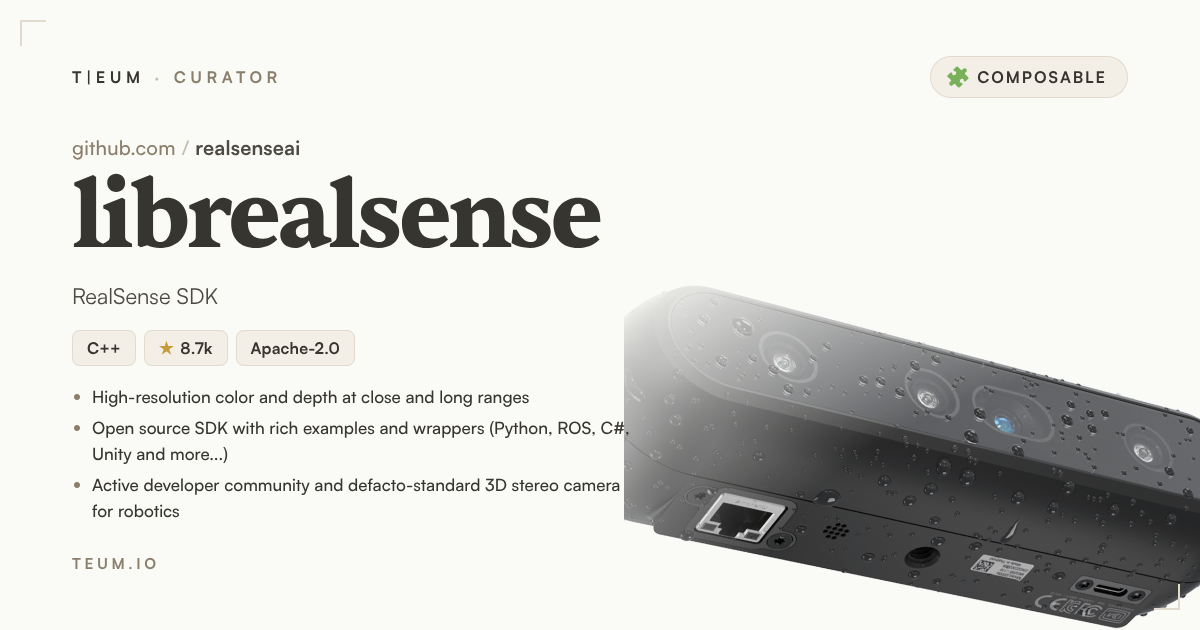 المصدرgithub.com/realsenseai/librealsense
TA
5mo ago320 مشاهدات0 ردود
Depth Cameras as LEGO Bricks: What librealsense Unlocks
The SDK that turns Intel RealSense hardware into a composable building block for any stack
A robotics engineer in Seoul once told me he spent three weeks writing glue code just to read a single depth frame from a camera. Three weeks — not building a product, just negotiating with hardware.
Setting
Intel's RealSense line of depth cameras (devices that see distance the way a human eye sees color) has been around since 2014. The cameras themselves are genuinely capable: structured-light and stereo sensors that spit out point clouds, infrared streams, and RGB video simultaneously. The original Intel SDK worked, but Intel wound down active RealSense development. realsenseai stepped in, forked the codebase, and has kept it alive and updated — the last push was May 2025, and the repo sits at over 8,700 stars.
The project lives at realsenseai/librealsense and describes itself plainly: RealSense SDK. No marketing copy, no landing-page promises. That restraint is the first signal that this is a tools-person's tool.
The Story
librealsense does exactly one thing: it gives your code clean, consistent access to RealSense camera hardware. C++ at the core, with official wrappers for Python, C, Node.js, and ROS (a robotics middleware). It abstracts away USB negotiation, firmware quirks, and sensor synchronization so you never have to think about them again.
Here is a concrete scenario. You are building a people-counting system for a retail store. You need to know how many bodies are in a frame — not just pixels, but real spatial presence. Without librealsense, you write hundreds of lines to initialize the device, configure streams, and handle dropped frames. With librealsense's Python wrapper, you initialize the pipeline in about fifteen lines, grab aligned color and depth frames together, and hand them straight to a computer-vision model.
Now the composability story starts. That depth frame is just a numpy array (a grid of numbers Python already understands). You can pipe it directly into OpenCV for image processing, into MediaPipe for pose detection, or into a custom PyTorch model. The SDK is the first brick; everything else snaps on.
Two combos worth naming:
librealsense + Supabase — capture per-frame metadata (timestamp, detected object count, spatial coordinates) and stream it to Supabase (an open-source Firebase alternative built on Postgres). You get a real-time database of physical-world events with zero extra infrastructure. A small dashboard built in Next.js (a React framework for server-rendered web apps) can then visualize foot traffic over time — a deployable product in a weekend.
librealsense + Next.js API routes — run the Python SDK process on a Raspberry Pi edge device, POST structured JSON to a Next.js backend, and expose the data via a simple REST endpoint. The camera becomes a sensor-as-a-service node on your local network. Any frontend, any analytics tool, any automation can subscribe.
The supported hardware families visible in the project documentation — the D435i, D455, D457, D555, D405 — cover a wide price-to-resolution spectrum, so you can prototype with a cheaper unit and swap to a more precise sensor without changing a single line of application code. That portability is the composability working at the hardware layer too.
The Insight
The best modules do not try to be entire systems. librealsense knows it is the hardware-to-data translation layer and nothing else. It does not bundle a UI, a cloud service, or an opinionated data model. That constraint is a feature: the output is a standard stream of frames and metadata, fluent in the data formats that the rest of the modern stack already speaks.
This is the LEGO philosophy made practical. A single brick is useless on a shelf. The value is in the connection points — and librealsense's connection points (Python bindings, ROS integration, plain C API) are clean, well-documented, and stable enough to build a product on top of.
If you are an indie maker who has looked at depth cameras and thought "this is for robotics labs, not for me," this SDK is the thing that changes the calculation. The hardware is affordable. The SDK is open source. The gap between a RealSense camera on your desk and a working prototype is now measured in hours, not weeks.
Build something with it — a body-tracking installation, a contactless kiosk, a volumetric scanner for small objects. If that prototype becomes a product, teum.io/sell is a natural next step for turning it into revenue.
한국어 요약
librealsense는 RealSense 뎁스 카메라(거리를 측정하는 3D 카메라)를 코드에서 쉽게 쓸 수 있게 해주는 오픈소스 SDK입니다. Python 바인딩 덕분에 OpenCV, Supabase, Next.js 등 익숙한 도구와 금방 조합할 수 있고, 카메라 모델이 바뀌어도 코드를 고칠 필요가 없습니다. 뎁스 카메라 기반 프로토타입을 빠르게 만들고 싶은 풀스택 개발자나 인디 메이커에게 진입 장벽을 크게 낮춰주는 도구입니다.
The best modules do not try to be entire systems — and librealsense's restraint is exactly what makes it composable.
#computer-vision#depth-camera#composable#sdk#indie-maker#kind:composable